How Much Does a Phase I ESA Cost in New Jersey?
When buying or financing commercial property, environmental due diligence is often a required step before closing a deal. One of the most common questions from property buyers, developers, and lenders is: how much does a Phase I Environmental Site Assessment (ESA) cost in New Jersey?
A Phase I ESA is designed to identify potential environmental risks associated with a property. The assessment helps buyers and lenders understand whether there may be contamination or environmental liabilities tied to the site.
While the exact cost can vary depending on several factors, most Phase I ESAs in New Jersey typically cost between $2,000 and $4,500. Understanding what influences this cost can help property buyers plan their due diligence process more effectively.

What Is a Phase I Environmental Site Assessment?
A Phase I Environmental Site Assessment (ESA) is a professional environmental investigation that evaluates the current and historical use of a property to determine whether there are potential environmental concerns.
The purpose of the assessment is to identify Recognized Environmental Conditions (RECs) that may indicate contamination or the potential presence of hazardous substances.
Phase I ESAs are conducted in accordance with ASTM E1527-21, a widely accepted standard by lenders, investors, and environmental regulators. Completing a Phase I ESA also allows property buyers to qualify for liability protections under the Comprehensive Environmental Response, Compensation, and Liability Act (CERCLA).
In New Jersey, Phase I ESAs are commonly required for:
Commercial real estate transactions
Property acquisitions
Bank financing or refinancing
Real estate development projects
Investor due diligence
Although the assessment evaluates environmental risks, it does not include soil or groundwater testing. Instead, it focuses on research, site inspection, and documentation.
What Does a Phase I ESA Include?
A Phase I ESA involves several components designed to evaluate the environmental history and condition of a property.
Environmental Records Review
Environmental professionals review federal, state, and local environmental databases to determine whether the property or nearby sites have been associated with hazardous materials, spills, or contamination.
In New Jersey, this typically includes reviewing records maintained by the New Jersey Department of Environmental Protection (NJDEP).
Historical Property Research
Understanding how a property was used in the past is an important part of environmental due diligence. Environmental consultants review historical sources such as:
Aerial photographs
Sanborn fire insurance maps
Historical topographic maps
City directories
Property records
These records help determine whether the property previously hosted operations that could create environmental risks.
Site Inspection
An environmental professional conducts a physical inspection of the property to observe current conditions. During the site visit, the consultant looks for indicators such as:
Chemical storage areas
Underground storage tanks
Stained soil or pavement
Waste disposal areas
Industrial equipment or operations
Photographs and observations from the site inspection are documented in the final report.
Interviews
Consultants may interview property owners, occupants, or local officials to gather additional information about the property’s history and environmental conditions.
Phase I ESA Report
All findings are compiled into a detailed Phase I ESA report, which evaluates the presence of environmental risks and identifies any Recognized Environmental Conditions. If potential contamination is identified, the report may recommend further investigation, such as a Phase II Environmental Site Assessment.
Average Cost of a Phase I ESA in New Jersey
The cost of a Phase I ESA can vary depending on the property, but most assessments in New Jersey fall within a typical price range.
Average Phase I ESA cost in New Jersey:
$2,000 – $4,500
Less complex properties usually fall on the lower end of the range, while more complex sites may cost more.
Below is a general estimate based on property type:
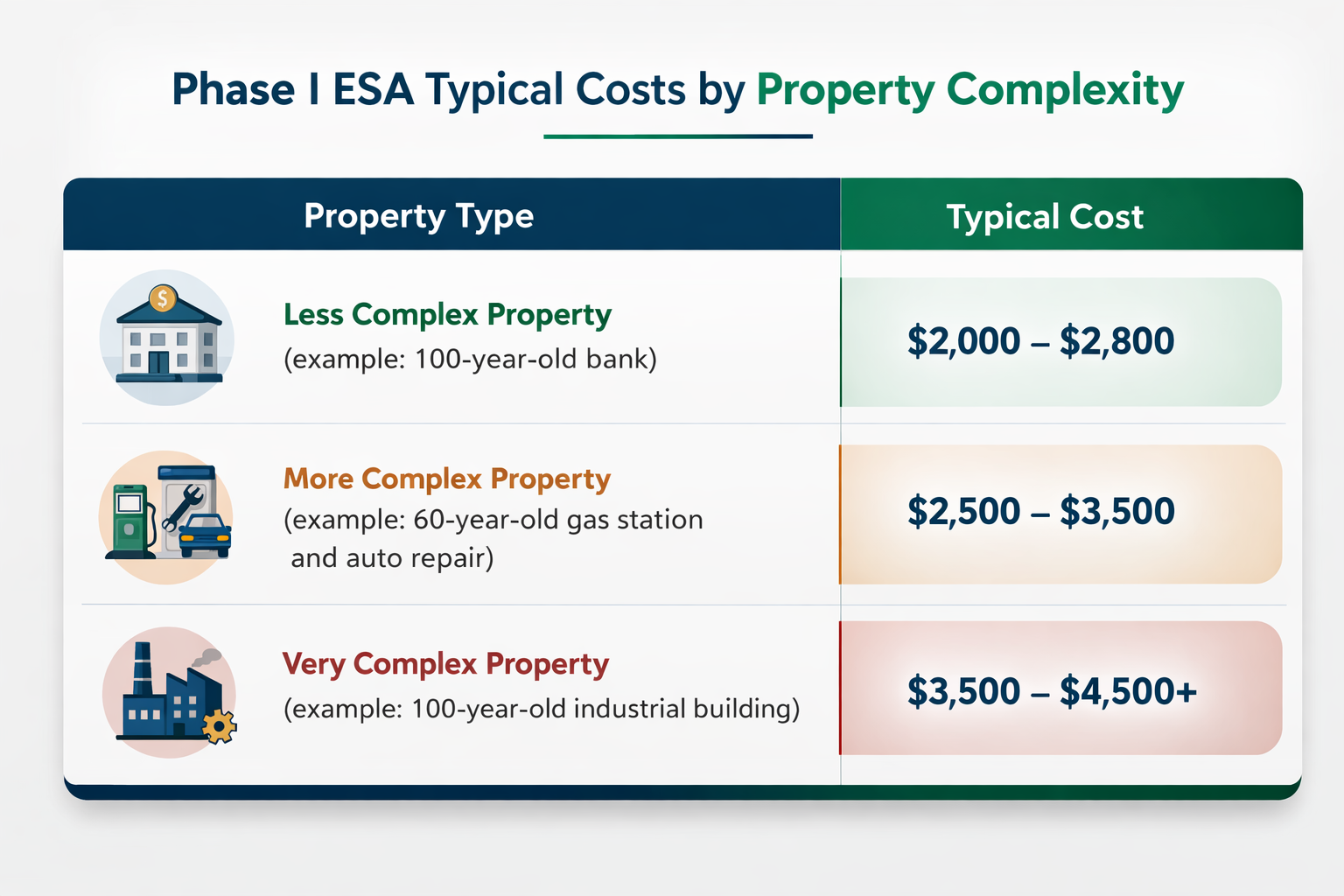
These are typical price ranges. Final cost depends more on property complexity than size alone. A small site with a complicated history can cost more than a larger site with a simple history.
While price is an important consideration, buyers and lenders should also ensure that the environmental consultant provides ASTM-compliant reports that meet lender requirements.
Factors That Affect the Cost of a Phase I ESA
Several factors can influence the cost of a Phase I Environmental Site Assessment.
1. Property Size
Larger properties generally require more time to inspect and research. A multi-acre industrial facility will typically cost more to assess than a small office building or retail space.
2. Property Type
Certain property types carry a higher risk of environmental contamination. Industrial properties, manufacturing facilities, gas stations, and automotive service locations often require more detailed investigation than typical commercial properties.
3. Historical Use of the Property
Older properties with multiple historical uses may require more extensive research. Environmental consultants may need to review additional historical documents to fully understand the site's past operations.
4. Location and Accessibility
The location of the property can affect both the cost and timeline of the assessment. If a site is difficult to access or requires special scheduling for inspection, additional time and effort may be required.
5. Expedited Turnaround Requests
In some cases, buyers or lenders need environmental reports completed quickly in order to meet closing deadlines. Expedited Phase I ESA services may slightly increase the cost but can significantly shorten the timeline.
Is the Cost of a Phase I ESA Worth It?
Although a Phase I ESA represents an additional cost during a real estate transaction, it provides significant value for property buyers and lenders.
Environmental contamination can result in extremely expensive cleanup costs and legal liabilities. Without proper environmental due diligence, a property buyer could become responsible for contamination caused by previous owners.
A Phase I ESA helps reduce these risks by:
Identifying potential environmental contamination before purchase
Protecting buyers from liability under federal environmental law
Satisfying lender environmental requirements
Providing confidence during commercial property transactions
Compared to the potential cost of environmental remediation, the price of a Phase I ESA is typically a small but critical investment.
How Oak Environmental Provides Efficient Phase I ESA Services
At Oak Environmental, we provide reliable and competitively priced Phase I Environmental Site Assessments throughout New Jersey. Our team works with property buyers, developers, lenders, and attorneys to deliver high-quality environmental due diligence that meets both regulatory and lender requirements.
All of our Phase I ESA reports follow the ASTM E1527-21 standard, ensuring they are accepted by lenders and meet federal All Appropriate Inquiry requirements.
In addition to providing accurate and thorough environmental assessments, Oak Environmental focuses on efficiency. For many projects, our team can complete a Phase I ESA in as little as 10 business days, helping clients meet tight real estate transaction timelines.
Our services are frequently used by:
Commercial real estate developers
Property investors and buyers
Banks and financial institutions
Real estate attorneys
Property managers
By combining experienced environmental professionals with efficient research and reporting processes, we help clients obtain the environmental information they need without unnecessary delays.
When Do You Need a Phase I ESA in New Jersey?
Phase I Environmental Site Assessments are typically required during commercial real estate transactions. However, they may also be recommended in several other situations.
Common scenarios include:
Purchasing commercial property
Refinancing or securing bank loans
Real estate development projects
Investment property acquisitions
Liability protection under federal environmental law
Many lenders require a Phase I ESA before approving financing for commercial real estate transactions. Conducting the assessment early in the due diligence process can help prevent delays later in the transaction.
Choosing the Right Environmental Consultant
When selecting an environmental consultant for a Phase I ESA, property buyers and developers should look beyond price alone. The quality and reliability of the assessment are equally important.
A qualified environmental consulting firm should offer:
Experience conducting Phase I ESAs in New Jersey
Knowledge of NJDEP environmental regulations and databases
ASTM-compliant reports accepted by lenders
Efficient turnaround times
Working with a consultant who understands local environmental regulations and property history can help ensure that the environmental due diligence process is accurate and efficient.
Final Thoughts
The cost of a Phase I Environmental Site Assessment in New Jersey typically ranges from $2,000 to $4,500, depending on the size, complexity, and history of the property.
Although the price may vary, a Phase I ESA plays a critical role in protecting property buyers and lenders from potential environmental liabilities. Conducting proper environmental due diligence helps ensure that commercial real estate transactions proceed with confidence.
If you need a Phase I ESA in New Jersey, Oak Environmental provides reliable environmental assessments with efficient turnaround times. In many cases, our team can complete Phase I ESA reports in as little as 10 days, helping keep your real estate transaction on schedule.
Related Phase I ESA Articles:
How Fast Can You Get a Phase I ESA in New Jersey?
What Do Lenders Require in a Phase I ESA in New Jersey?
What Is Included in a 10-Day Phase I ESA in New Jersey?
Need a 10-Day Phase I ESA in New Jersey? Request a quote.